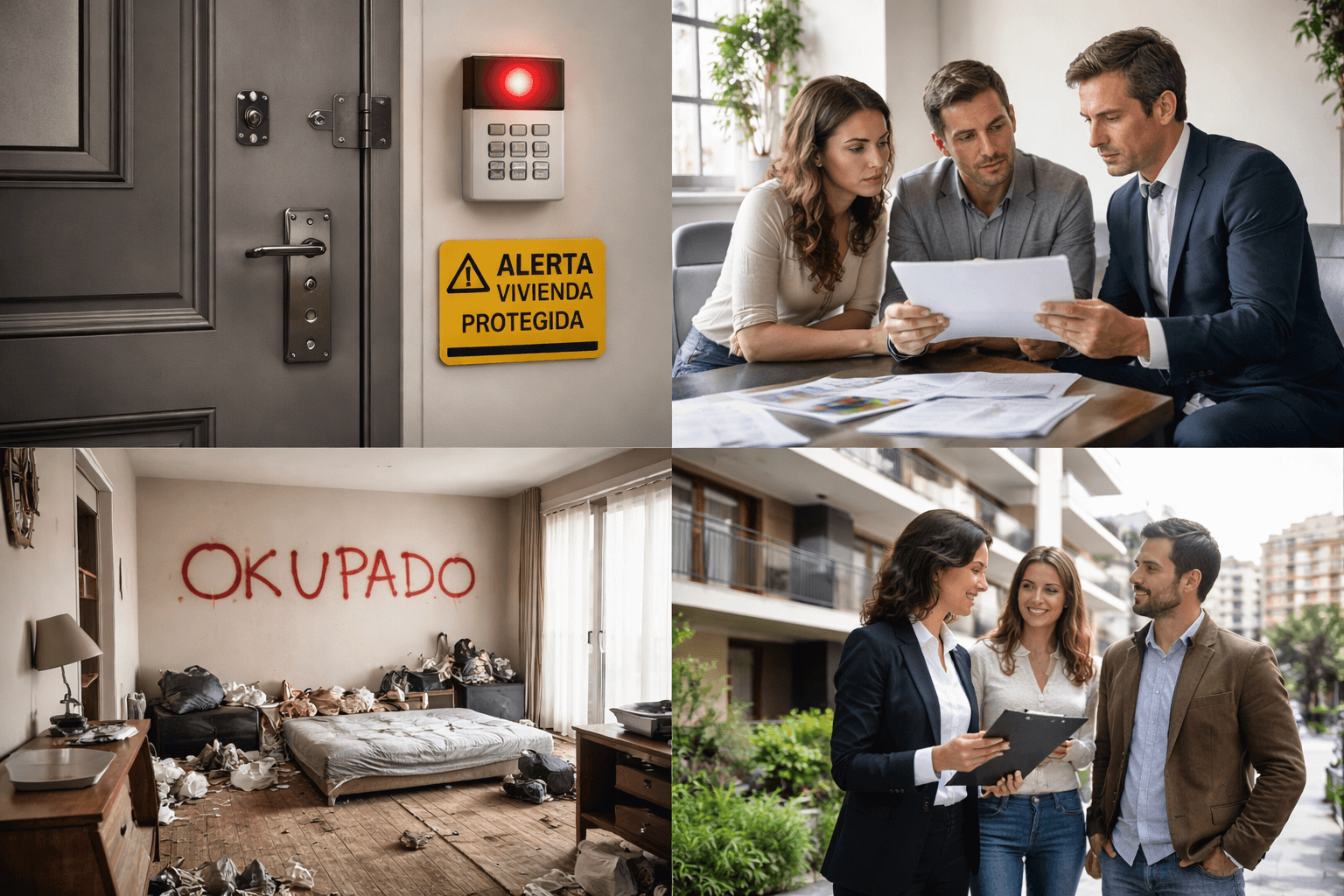
In recent days, various media outlets have reported significant news: the Valencian Housing and Land Agency (EVHA), dependent on the Valencian Generalitat, has awarded a multimillion-euro contract for the installation of alarm and security systems in public housing stock with the aim of preventing illegal squatting.
Beyond the public investment in these devices, the news raises an issue that concerns both administrations and private owners: illegal squatting exists, creates social impact and conditions access to housing, especially when it affects properties that should be allocated to families who follow the legal channels.
From a prudent and objective perspective, it is worth clarifying that not all vacant properties are at risk nor are all areas equally affected. Official statistics available, both at regional and national levels, do not always accurately reflect the scale of the phenomenon, since many situations do not reach the courts or are resolved by other means.
What public administrations themselves do confirm is that illegal squatting poses a direct obstacle to the rehabilitation, allocation and social use of housing, as well as generating coexistence, security and deterioration problems for the real estate stock. This institutional recognition is, in itself, evidence that it is a reality that requires preventive, not just reactive, measures.
The fact that the Generalitat has reinforced its security systems in public housing should not be interpreted as alarmism, but as responsible prevention. If the administration protects its housing stock, the private owner — especially one who buys as an investment or second home — must also adopt an appropriate strategy.
This is especially relevant for the international client, who is often unaware of the legal framework, response times and preventive tools available in Spain.
From professional experience in the real estate market, there is clear consensus: prevention begins long before the problem appears. Keeping the property in use, correctly managed and with periodic monitoring drastically reduces the risk. Likewise, having adequate enclosures, deterrent systems and proper document management facilitates a rapid response in case of an incident.
But above all, it is essential to buy well from the start. Location, type of property, surroundings, legal status and professional support make the difference between a peaceful investment and a constant source of worry.
At Alma Homes we understand that our job does not end at the notary signing. We accompany our clients —national and international— so that their investment or second home is secure, viable and consistent with their objectives.
Informing with transparency, anticipating scenarios and helping to make responsible decisions is part of a more conscious real estate vision, where investing with purpose also means protecting the social and patrimonial value of housing.
Because security does not begin with an alarm, but with a good decision.